


Related articles



How to Grow Limes


Growing your own citrus trees is an incredibly rewarding experience, and there’s nothing quite like using your own oranges, lemons or limes in the kitchen (or cocktail cabinet). And it’s the latter we’ll be focusing on today (lime trees, not the cocktails).
With their zingy fruit, perfect for Southeast Asian and Latin American cuisines, fragrant white flowers and lush evergreen foliage, these compact powerhouses are ideal for Mediterranean garden schemes and patio growing. But how do you grow one, that’s what you want to know. Fear not, we’re going to walk you through everything lime-related (but not those rental bikes you get in London, you can keep those).
Jump to:
- Growing a lime tree from seed
- Growing a lime tree from cuttings
- Growing lime trees in pots
- Watering lime trees
- Feeding lime trees
- Pruning lime trees
- Can you grow citrus trees outdoors in winter?
How to grow a lime tree from seed
Now, a quick disclaimer. Growing a lime tree from seed is very much possible, however it will take significantly longer (often many years) before you have a fully grown, fruit-bearing tree than were you to, say, buy an established young tree in a 5L pot (cough, cough). So, if fruit production is important to you, then that’s worth bearing in mind. However, if you’re prepared to be patient with it, then it’s undoubtedly a very cool thing to do!
What to do with your seed
Get yourself any old lime from the supermarket, slice it in half and remove the seeds. Wash them in water, then dry them off with a paper towel and place them on a damp paper towel. Fold the paper towel over and then seal it in a zip-lock bag. Take the bag and place it somewhere warm and dark. In two to three weeks you should see some little sproutlets if germination has been successful.
What to do with your seedling(s)
Next, it’s time to pot your seedlings on. Fill a propagation/potting on tray with compost formulated for seedlings. If you’re making your own mix, mix four parts coco coir, two parts high-quality compost and two parts perlite. Place your seedlings in, give them a watering and then place the tray somewhere warm that receives at least six hours of direct sunlight per day.
Once the seedlings have three sets of true leaves and are a few inches tall, you can transition them into slightly larger pots. Continue scaling up your pot size over the next weeks and months until you have a healthy young tree growing. Don’t panic if your plant takes its sweet time to grow, we’re not blessed with the warm, long growing season that a hotter climate would provide, so growth is naturally going to be smaller than, say, were you to be growing your tree in sun-kissed southern Italy.

How to grow a lime tree from cuttings
Growing lime trees from cuttings isn’t dissimilar to doing so from seed, you just skip out the first stages. Take your cutting from an existing mature lime tree; you want to snip semi-hardwood cuttings, these are those bits of the plant that sit in the sweet spot between new green growth and grey wood. Try to choose a piece of the plant that has no fruits or flowers on it, so that the plant’s energy all goes into root production.
Taking the cutting(s)
To take your cutting, use a pair of sterilised secateurs or garden scissors (use some rubbing alcohol to clean your tools). Cutting at a 45-degree angle, snip your plant just below a leaf node to give yourself a piece that’s roughly 10-15cm long. Strip the lower part of the cutting of its leaves, so that only the uppermost couple of leaves remain.
Planting your cutting
Dip the stripped end of your cutting in rooting hormone, and then place it into a pot filled with rooting compost (also known as cutting compost). Firm the cutting in and give it a light watering. Create a basic humidity dome by cutting the bottom half off of an old 2L plastic bottle, then upturn it and place over your cutting. Position the pot in a warm spot with bright (but indirect) light and leave it to root. Only water if the compost becomes dry to the touch.
Successful rooting – what next?
Check back in on your cutting in seven or eight weeks time. You’ll be able to tell if it’s successfully rooted nice and easily. Just give the stem a gentle tug upwards and if you feel any resistance, rather than it easily sliding out, then you’re in luck – you’ve got roots. Remove the humidity dome and proceed to grow your cutting as you would any other young citrus plant. Place somewhere bright, sunny and warm (a conservatory works brilliantly, so too does a patio in the warmer periods of the year) and keep well-watered.

Planting lime trees in pots
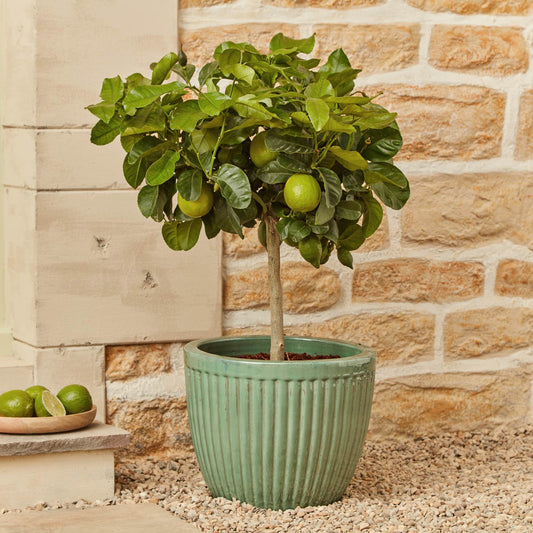
By far the simplest way to grow a lime tree is to buy a healthy, established young plant, such as those we provide here at Roots. That way, you’ll get fruit more quickly (with many of the trees we sell already having fruit on them) and no chance of your plant failing in the way that a seed or cutting-grown plant might. Choose a pot that’s slightly bigger than the plastic one your plant arrives in, and repot every two or three years (or sooner should it become root bound).

Watering lime trees
Because citrus trees won’t survive outdoors in British winters, the chances are you’ll be growing your lime tree in a pot, rather than the open ground. You need to bear that in mind when it comes to watering your plant; container-grown plants dry out more quickly than those grown in the ground, and thus require more frequent watering. That said, you don’t want to waterlog your plant, so as a rule of thumb, assess the top inch or so of compost. If it feels dry to touch, give your lime tree a watering. Where possible, water with rainwater.

Feeding lime trees
Citrus trees are pretty hungry feeders – join the club – so you’ll want to feed your lime tree throughout the growing season. There are purpose-formulated liquid citrus feeds you can buy easily online or at your local garden centre. Generally, they’ll recommend you apply the feed either fortnightly or monthly.

Pruning lime trees
Your lime tree won’t need much by way of pruning save for removing any dead, damaged or diseased wood, and thinning out any interior branches that are leading it to become overly congested (this helps ensure good airflow around the plant which reduces the risk of disease).
The winter question…
Despite our country becoming milder and milder due to climate change, we’re still a temperate nation and that means it’s just too cold in the winter months for citrus trees to reliably survive outdoors, even if you took protective measures. So, grow your plant in a pot and move it into a greenhouse or conservatory during the winter. They look excellent in a terracotta pot, so you’re not missing out by container growing.
Final thoughts
There you have it, everything you need to know to be growing your own delicious limes at home. We’ve written extensively about other citrus plants before, including a grow guide for lemon trees, so make sure you give those a peruse to complete your Mediterranean planting education. Now, if you’ll excuse me, I’m off to find a margarita…
Last updated: 12/06/2026